Last Updated: October 23, 2026
Quick Summary
CNC machining is a manufacturing process that uses computer-controlled machine tools to remove material from a workpiece, creating precise custom parts with high repeatability. Pre-programmed software directs cutting tools along multiple axes to shape metal, plastic, or other materials into finished components with consistency that manual methods cannot match.
- CNC machining is subtractive, starting with solid material and removing excess to reveal the finished part.
- The process involves CAD design, CAM toolpath generation, machine setup, and cutting with precision within fractions of a thousandth of an inch.
- Mills handle complex multi-feature parts while lathes excel at cylindrical components like shafts and bushings.
- Most functional parts work fine with tolerances of ±0.010 to ±0.015 inch, which cost less than tighter tolerances.
- CNC machining outperforms 3D printing for production-ready parts that must withstand stress and maintain tight tolerances.
Table of Contents
- What CNC Machining Is and How It Works
- The CNC Machining Process: From Design to Finished Part
- Common CNC Machine Types and Their Operations
- Materials for CNC Machining: Selection and Performance
- Achieving Tight CNC Machining Tolerances and Surface Finish
- CNC Machining vs. 3D Printing: Which Process Is Right for Your Project
- Design for CNC Manufacturability and Cost Control
- Conclusion
- Frequently Asked Questions
What CNC Machining Is and How It Works
CNC machining is a manufacturing process that uses computer-controlled machine tools to remove material from a workpiece, creating precise custom parts with high repeatability.
Unlike manual machining, where an operator guides the tool by hand, computer numerical control automates the entire cutting process. A machine controller reads G-code instructions and translates them into precise movements: the spindle rotates at programmed speeds while the workpiece or cutting tool moves along X, Y, and Z axes.
The real power of CNC machining lies in handling complex geometries that would be nearly impossible to machine manually. Intricate curves, precise holes, and tight tolerances become routine, delivering consistency that manual methods cannot match.
At Black Creek Works, we've built our precision manufacturing practice around this technology. CNC machining serves multiple purposes, from rapid prototyping for engineers testing new designs to custom branded promotional items and functional parts for small manufacturers.
The CNC Machining Process: From Design to Finished Part
The journey from idea to finished part involves several distinct stages. Understanding this workflow helps you anticipate timelines, plan for revisions, and communicate effectively with your manufacturing partner.
CAD Design and Digital Preparation
Everything begins with a digital design. You'll work with CAD (computer-aided design) software to create a precise 3D model defining every dimension, curve, and feature. CAD files are the blueprint that drives everything downstream.
Your CAD design must account for how the part will actually be machined, which is where design for CNC manufacturability becomes critical. Sharp internal corners require tool changes or multiple passes. Blind holes need careful planning to avoid tool breakage.
Working with a manufacturing partner early in the design phase pays dividends. Engineers and designers can suggest minor modifications that reduce machining time, lower costs, and improve part quality, all without compromising your functional requirements. A 0.125-inch fillet instead of a sharp corner might seem minor, but it can reduce cycle time significantly and extend tool life.
CAM Software and Toolpath Generation
Once your CAD design is finalized, it moves into CAM (computer-aided manufacturing) software, where the digital design transforms into machine instructions. CAM software analyzes your part geometry and generates a toolpath, the precise route the cutting tool follows to remove material.
Toolpath generation considers the cutting tool diameter, spindle speed, feed rate, and material. Aluminum machines quickly and produces long, curled chips. Steel requires slower speeds and careful coolant application. Plastics like polycarbonate need gentle handling to avoid melting or cracking.
CAM software also determines tool changes, sequencing, and setup orientation. A complex part might require multiple setups, each adding time and the possibility of alignment errors. Skilled CAM programmers minimize setups while ensuring the cutting tool can access every feature.
Machine Setup and Cutting
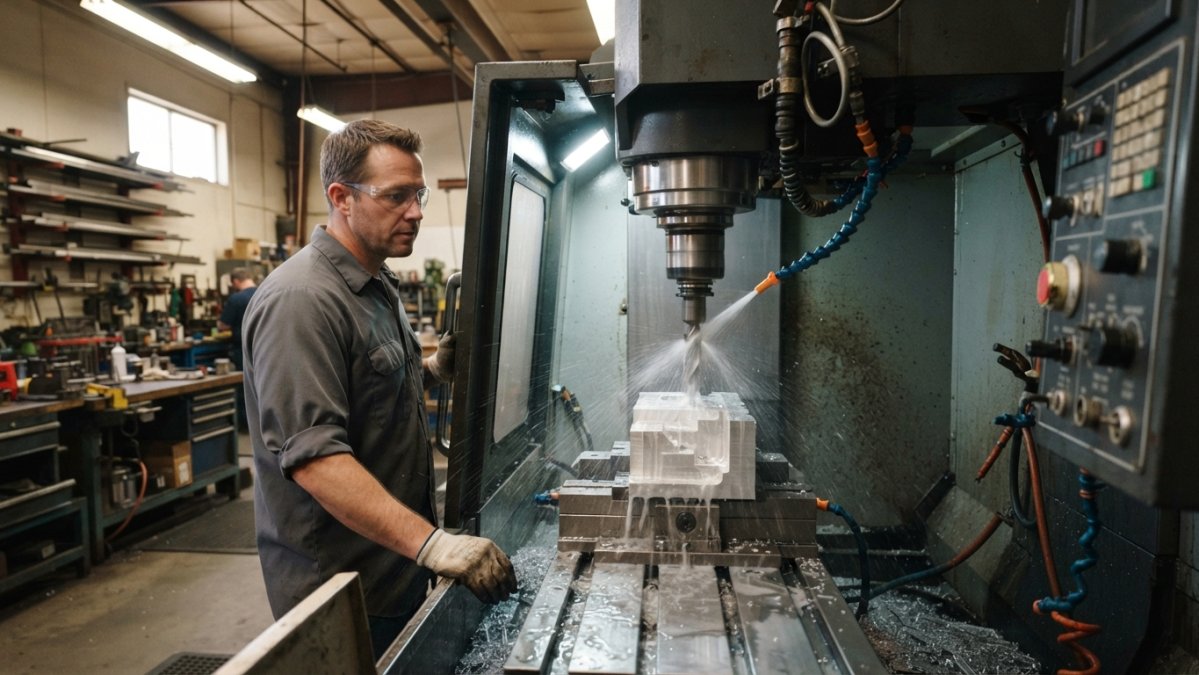
With the toolpath programmed and verified, the part moves to the CNC machine. The operator secures the raw material in a vise or other workholding device.
The machine controller reads the G-code and begins executing the program. The spindle spins at the programmed speed, from a few hundred RPM for large tools in hard materials to tens of thousands for small tools in softer materials.
Throughout the cutting cycle, the CNC machine maintains position accuracy within fractions of a thousandth of an inch. Sensors monitor spindle load, temperature, and tool condition, and modern machines stop before damage occurs if a tool breaks, coolant runs out, or the workpiece slips.
Common CNC Machine Types and Their Operations
Milling, Turning, and Drilling
The most common CNC machine types each excel at specific operations. Understanding their capabilities helps you choose the right process.
A CNC mill removes material using a rotating cutting tool while the workpiece remains stationary. The tool moves along multiple axes (typically X, Y, and Z) to create pockets, slots, and holes.
A CNC lathe rotates the workpiece while a cutting tool moves along two axes to shape it. Lathes excel at cylindrical parts, shafts, bushings, and threaded components, producing tapers, grooves, and threads with precision. They're highly efficient for round parts because the workpiece rotation itself generates the cutting motion.
CNC drilling machines are specialized for high-volume drilling operations. They position and drill multiple holes with precision. While a mill can drill holes, a dedicated drilling machine optimizes for this single operation and can be faster for high-volume work.
The choice depends on part geometry. A bracket with features on different faces calls for a mill. A precision shaft calls for a lathe. A part with dozens of identical holes might benefit from a drilling machine.
Materials for CNC Machining: Selection and Performance
The material you choose affects cost, performance, and manufacturability. Each material has different cutting characteristics, strength properties, and cost profiles.
Aluminum machines quickly and produces excellent surface finishes. It's lightweight, corrosion-resistant, and ideal for applications where weight matters. Aluminum is a popular choice for prototypes and custom components because it's affordable and easy to machine.
Steel offers superior strength and wear resistance compared to aluminum, but machines more slowly and requires careful coolant management to prevent heat buildup.
Brass and copper machine beautifully and are chosen for specific applications, electrical conductivity, corrosion resistance, or appearance. They're more expensive than aluminum or steel but sometimes essential for the application.
Material selection should consider functional requirements first: what loads will the part experience, does it need to resist corrosion, will it conduct electricity? Once those are identified, manufacturability and cost become secondary.
Achieving Tight CNC Machining Tolerances and Surface Finish
Tolerances define the acceptable range of variation for each dimension. A tolerance of ±0.010 inch means the actual dimension can be anywhere from 0.010 inch smaller to 0.010 inch larger than the nominal size.
Surface finish describes the texture of the machined surface. CNC machining typically produces finishes ranging from rough (after heavy cutting) to smooth mirror-like finishes. The finish depends on cutting tool geometry, spindle speed, feed rate, and material.
Achieving and maintaining tolerances requires attention throughout the process: a rigid, well-maintained machine, secure and properly aligned workholding, and a sharp cutting tool appropriate for the material and operation. If the part isn't positioned correctly initially, no amount of precision during cutting will compensate.
Realistic tolerance expectations matter. Holding ±0.001 inch across an entire part is expensive and time-consuming. Most functional parts work fine with ±0.010 to ±0.015 inch tolerances.
CNC Machining vs. 3D Printing: Which Process Is Right for Your Project
Both CNC machining and 3D printing create custom parts, but they work in fundamentally different ways. Understanding when to use each prevents costly mistakes.
CNC machining excels at high-strength parts, tight tolerances, and production runs. Once the toolpath is programmed, parts are produced quickly and consistently, and the finished parts are solid and durable.
3D printing excels at complex geometries, rapid prototyping, and low-volume production, with minimal material waste and no expensive tooling or extensive setup. However, 3D printed parts are often weaker and require post-processing.
The choice often comes down to your specific requirements. Need a prototype quickly to test a concept? 3D printing might be faster. Need production-ready parts that will hold up in the field?
Design for CNC Manufacturability and Cost Control
Smart design reduces machining time, improves quality, and lowers cost. A few principles applied early pay dividends throughout manufacturing.
Minimize tool changes. Each time the machine stops to change tools, time is added to the cycle. Grouping operations that use the same tool reduces changeovers.
Avoid unnecessary complexity. Sharp internal corners require special tools or multiple passes. Undercuts and overhangs complicate fixturing and may require secondary operations.
Design with standard tool sizes in mind.
Communicate your tolerance requirements clearly. If a dimension doesn't need to be tight, specify a looser tolerance.
Consider the material early. Some materials are easier to machine than others. Aluminum machines faster than steel. Softer materials generally machine faster than hard materials.
At Black Creek Works, we discuss manufacturability with clients before cutting begins.
Conclusion
CNC machining transforms digital designs into precision metal and plastic parts with repeatability that manual methods cannot match. From rapid prototyping to production runs, computer numerical control has become the backbone of custom manufacturing.
The process demands attention to detail at every stage, from initial CAD design through CAM programming, machine setup, and final inspection. Understanding how CNC machining works helps you make better design decisions, communicate effectively with your manufacturing partner, and anticipate realistic timelines and costs.
Black Creek Works specializes in precision CNC milling alongside 3D printing and laser engraving. We work with engineers prototyping new designs, small manufacturers producing custom components, and businesses creating branded promotional items. Our team reviews your design for manufacturability, discusses material options, and delivers parts with the precision and quality your project demands. Get started with Black Creek Works and transform your ideas into finished parts.
Frequently Asked Questions
What does CNC mean, and how is it different from manual machining?
CNC stands for computer numerical control. Unlike manual machines where an operator guides the cutting tool by hand, CNC machines follow pre-programmed instructions (G-code) generated from digital designs. This automation delivers consistent accuracy, repeatability, and speed, critical for producing identical parts without operator fatigue or variation. A CNC machine can run unattended once the program is loaded, making it ideal for both prototypes and production runs.
What materials can you machine with CNC, and how do they affect the process?
CNC machines work with metals (aluminum, steel, brass, titanium), plastics (acetal, polycarbonate, nylon), and composites. Material choice affects cutting speed, tool wear, surface finish, and cost. Aluminum machines quickly and produces excellent surface finishes; steel requires slower speeds and more robust tooling. Plastics can melt if speeds are too high. Your design, tolerances, and end-use environment determine the best material, softer metals cost less to machine, while harder materials demand precision and longer cycle times.
How tight can CNC machining tolerances be, and what does that cost?
CNC machines routinely hold tolerances of ±0.005 inch or tighter on metal parts, depending on machine condition, tool quality, and workholding setup. Tighter tolerances require slower speeds, specialized tooling, and inspection, all increase cycle time and cost. Standard tolerances (±0.010 inch or looser) are faster and cheaper. Discuss your tolerance needs upfront; over-specifying tolerances drives unnecessary cost, while under-specifying can cause assembly or fit problems.
When should I choose CNC machining over 3D printing for a prototype or small-batch part?
Choose CNC machining for parts needing tight tolerances, superior surface finishes, or high strength (metal). CNC excels at small batches of functional metal components and delivers parts ready to use without post-processing. Choose 3D printing for complex geometry, rapid iteration, or when material doesn't matter. For small production runs under 50 units, CNC is often faster and more cost-effective than tooling for injection molding. The decision depends on part complexity, material requirements, and timeline.